Rose Theatre, Rugeley
There’s something wonderfully bonkers about Little Shop of Horrors. On the surface it’s a quirky comedy about a meek florist who discovers an unusual plant, but beneath the laughs lies a deliciously dark tale of ambition, love, greed and the consequences of getting exactly what you wish for. Howard Ashman’s witty book, coupled with Alan Menken’s infectious score, has deservedly become a musical theatre favourite, blending Motown, rock and comedy into a show that’s every bit as entertaining today as it was when it first appeared over forty years ago.
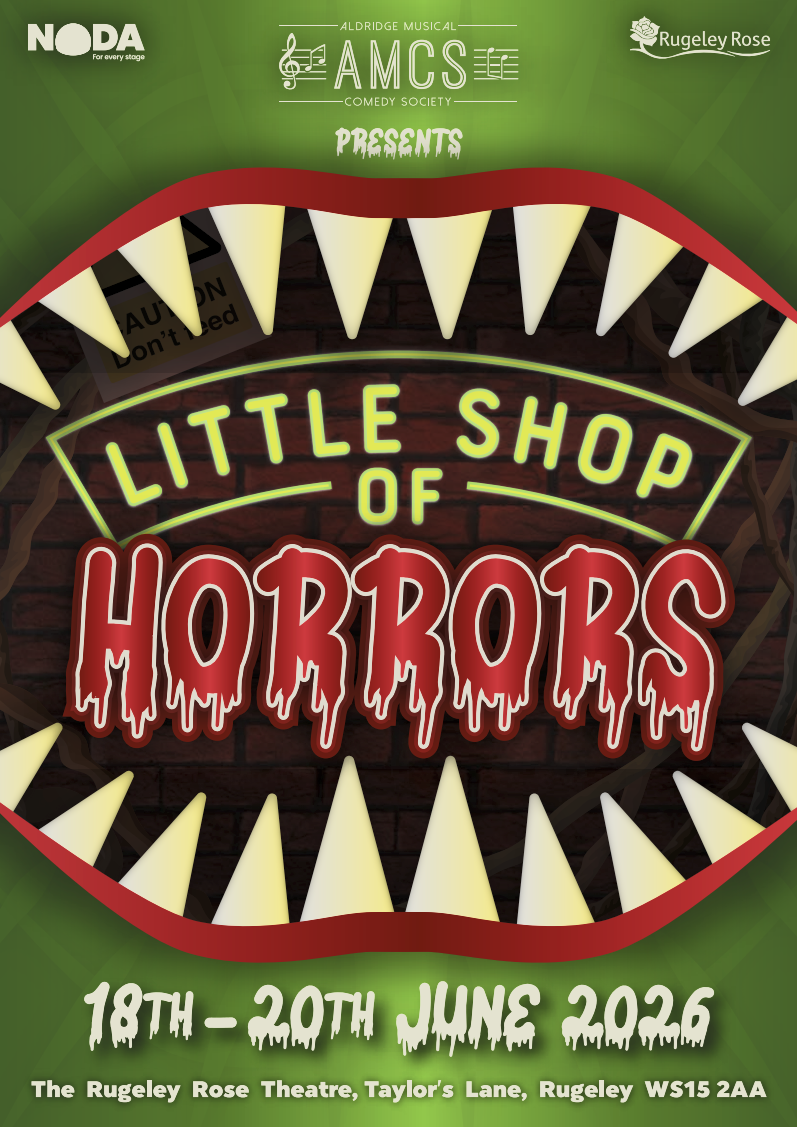
For their latest production at the Rose Theatre in Rugeley, Aldridge Musical Comedy Society embraced both the humour and the heart of the piece, delivering an afternoon that never lost sight of the story beneath the spectacle.
Director and Musical Director Mark Bayliss clearly understands that Little Shop of Horrors only works when the audience genuinely cares about its characters. Rather than simply chasing the laughs, he allowed relationships to develop naturally, making Seymour’s moral dilemma and his affection for Audrey feel believable. Musically, the company sounded confident throughout, with well-balanced ensemble numbers and some particularly enjoyable harmonies.
The choreography by Sarah Beckett suited both the intimate stage and the period feel of the production. It never felt overcomplicated, instead complementing the music while allowing the performers’ personalities to shine through. The street-urchin trio were especially well served, with movement that captured the show’s playful rhythm without ever distracting from the vocals.
Leo Wright made for an engaging Seymour. His awkward charm was instantly likeable, and he portrayed Seymour’s transformation from timid flower shop assistant to reluctant celebrity with warmth and sincerity. Vocally he handled the score with confidence, particularly in the quieter, more reflective moments.
Opposite him, Lucy Talbot gave Audrey exactly the vulnerability the role needs. It would have been easy to lean too heavily into the comedy of Audrey’s exaggerated New York accent and mannerisms, but Lucy found the balance beautifully. Her performance of Somewhere That’s Green was one of the highlights of the evening, full of warmth, honesty and a voice that was simply a delight to listen to. If she sings around the house as beautifully as she did on stage, then her cats are very lucky indeed.
Their chemistry together was entirely believable, and that really paid off during “Suddenly, Seymour.” For me, this was the musical highlight of the evening. Both voices blended beautifully, the emotion felt genuine rather than forced, and it was one of those performances that stays with you. In fact, it was the number I found myself humming all the way home—surely the best compliment you can pay any musical.
As Mushnik, Richard Beckett brought plenty of dry humour to the role, delivering his comic moments with excellent timing while maintaining the character’s slightly world-weary outlook. I particularly enjoyed the little dance steps and physical flourishes he sprinkled throughout the performance; they felt completely natural for the character and added an extra layer of comedy without ever becoming overplayed. His performance of “Mushnik and Son” with Leo Wright was another highlight of the evening, full of warmth, charm and impeccable comic timing.
The trio of Crystal, Ronette and Chiffon — Chleo Hancox, Rebecca Oatley and Lucy Pountain — were outstanding throughout. Acting as both narrators and commentators, they injected energy into every scene. Their harmonies were consistently impressive, and together they provided much of the show’s infectious momentum. They looked as though they were enjoying every minute, and that enthusiasm quickly spread to the audience.
Every production of Little Shop of Horrors depends on having a memorable Orin Scrivello, and Mark Newman certainly didn’t disappoint. His sadistic dentist was gloriously over-the-top, full of swagger, arrogance and manic energy. His scenes were among the funniest of the evening, played with just enough excess to make the character outrageous without tipping into parody.
Of course, the real star of the show is Audrey II. Peter Brown supplied a rich, commanding voice that gave the carnivorous plant exactly the right amount of menace and personality, while Emma O’Quinn, operating the increasingly enormous puppet, deserves enormous credit. Puppetry of this scale is physically demanding and often overlooked, yet her work brought Audrey II convincingly to life. The coordination between voice and movement was seamless, allowing the audience to forget there were two performers involved and simply enjoy one of musical theatre’s most iconic creations.
It would be remiss not to acknowledge the contribution of the wider company. There are simply too many performers to mention individually, but the ensemble played a huge part in the success of the production. They brought energy, commitment and character to every scene, creating a lively world around the principal cast and demonstrating the strength in depth that AMCS clearly enjoys.
The band also deserves a special mention. Under Mark Bayliss’s musical direction, they provided an accomplished accompaniment throughout, driving Alan Menken’s memorable score with confidence and sensitivity. They supported the singers beautifully without ever overpowering them, and the balance between them and the stage was excellent.
Behind the scenes, Stage Manager Mick Perry ensured everything ran with the sort of smooth efficiency that audiences rarely notice—but reviewers certainly do. Scene changes were slick, cues were precise and the whole production flowed effortlessly from one scene to the next.
There were also some lovely technical touches. I particularly enjoyed the advancing clock, a simple but effective piece of stagecraft that subtly reinforced the passing of time as Seymour’s fortunes changed. It was the sort of detail that could easily go unnoticed, yet it added another layer to the storytelling.
The lighting complemented both the comedy and the darker moments of the piece, while the sound quality was consistently first class. Wireless microphones can often be the Achilles’ heel of amateur musical productions, with the inevitable dropouts or fluctuating sound levels. Happily, there were no such issues here. Every principal and every member of the ensemble could be heard clearly throughout, allowing the audience to become completely immersed in the performance rather than distracted by technical glitches.
This was my first opportunity to see a production by Aldridge Musical Comedy Society, and it proved to be a genuine pleasure. They have made an excellent first impression and are a very welcome addition to our peripatetic drama competition. On the strength of Little Shop of Horrors, I’ll certainly be looking forward to seeing what AMCS brings us next. Now, remind me not to let Loe near my plants..
Reviewed By – David T.
Comments are closed