
Performing Groups and Bfame Team Information.
Welcome

Schedule for the festival at Highbury – which is, as always, subject to change.
Tech Times
We request that local groups do their tech run on:-
Friday evening – 27th March.
Each group will be issued a ‘get in’ time and plus their 30 minutes tech time on stage.
Encore! – 7.15-7.45pm (GET IN – 7PM)
Oldbury Rep – 7.45-8.15 (GET-IN 7:30PM)
The Grange Players – 8.15-8.45pm (GET-IN 8PM)
We ask all groups to arrive for their get in on time and be ready for their allocated tech rehearsal session.
Saturday – 28th March
10.30am – All groups can arrive and will be allocated a dressing room for the day. Please see dressing room information.
Tech times for Saturday
Impact Youth – 10.45-11.15 (GET-IN 10:30AM)
Broadly Speaking Productions – 11.15-11.45 (GET-IN 11AM)
During GET-INS we ask that groups keep noise down as much as possible as other groups will be having their tech time on stage.
If your submission is a published play, please remember to hand your performance licence to our stage manager at the start of your tech time.
Session One & Two Information
There are three sessions making up Bfame, we ask that you pay to attend any session you are not performing in. Complementary tickets will be granted to your team for your performance session. We would recommend watching sessions you’re not performing in to support the festival and learn from adjudicators comments.
Session One – 12 o clock
Session Two – 4 o clock
Awards Ceremony – 8 o clock
At the end of Session One and Session Two there will be the adjudication of the play performed.
Between plays there is a 20 minute interval.
There should be a 1 hour break between each session, however time can and will slip as running times are never exact.
Performance Times
These are estimated and Subject to Change..
Encore! – 12 – 12:50pm
Impact Youth 1:10 – 2:00pm
Oldbury Rep – 4:10 – 4:40pm
The Grange Players – 5:00 – 5:30pm
Broadly Speaking Productions – 5:50 – 6:20pm
Dressing Room Information & Arrival Time
Saturday – 28th March 2026.
10.30am – All groups can arrive and will be allocated a dressing room for the day. That’s your space, please picnic, rehearse, do speed runs or just relax, just keep it down whilst the stage is in use oh and leave it tidy please.
Our green room has a kettle and is a good meeting point for all groups.
Dressing rooms are allocated by the size of groups competing.
Please remember to sign in and out of the building – the book is by the back stage door.
Session Three - Awards Night
The plan for the awards night are currently as follows.
8pm Curtain Up
Welcome
Looking Ahead to the Quarter and Semi – David
New Youth Section – Lesley
Bfame Excellence Award – Special – David
Summing up of the One Act Festival – Ruth
Summing up of the Peri Festival – David
Intival
The Awards – The Team
The Bar.
Tickets
Grrr..
Sadly our new and Improved system is taking longer to work than we expected. We will continue to work with the company in an attempt to get this sorted ASAP, however it’s looking increasing likely that this will be moved to our quarter and semi final… SO… We will need to revert to Plan B.
Please email Chair@Bfame.co.uk with your ticket requests and we will ensure you receive them.
Pricing..
Is currently set to £12 per session, per person. This for a single session.
Two sessions will be set to £20 per person
Our Golden Ticket – for all three sessions – will be set to £30 per person.
Stage Information
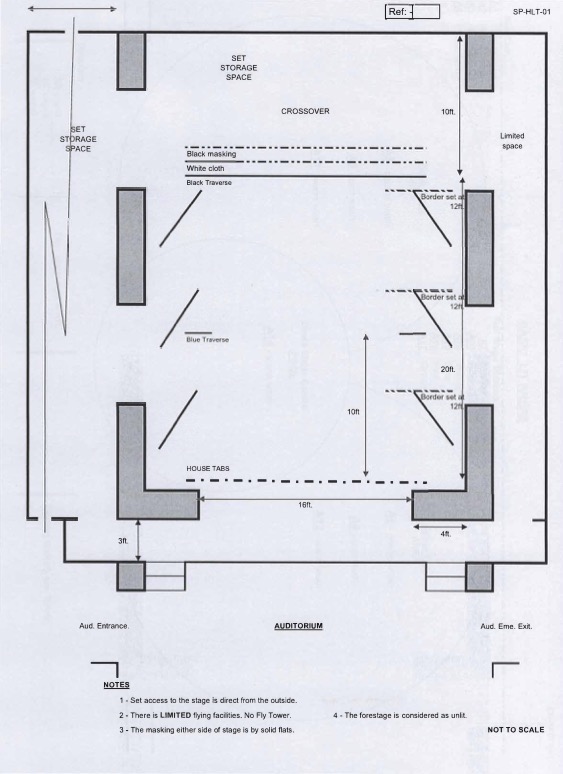
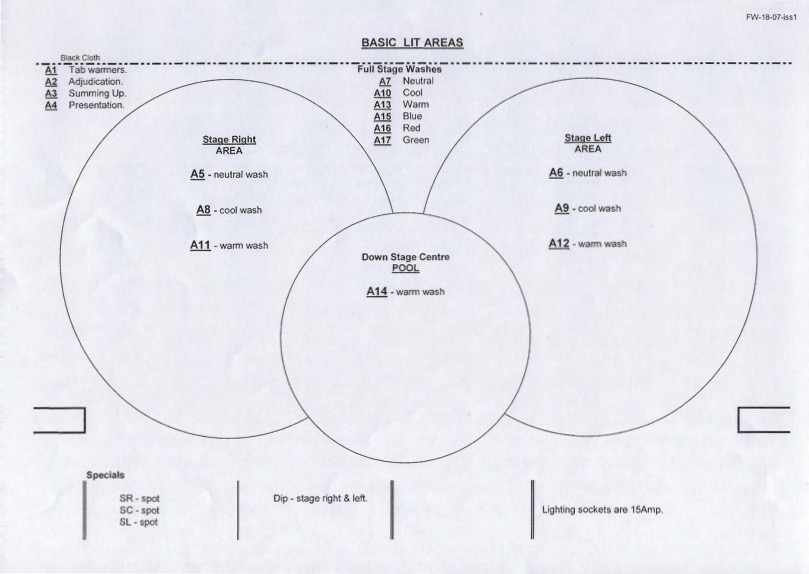
Highbury Theatre have provided the above stage plan and lighting guide. They can be viewed by clicking on the image OR downloaded by clicking on the coloured button.
What are the adjudicators looking for?
I’ve been asked this a lot! Below is a brief guide. Obviously every adjudicator is different, so please treat this information as guidance only.1. STAGE PRESENTATION (15 marks)While not a scientific measure, the Stage Presentation category can loosely be split into three key areas:Set, Scenery & Props – 5 marksA minimal or bare stage can work well—marks won’t be deducted if it aligns with the production’s style, genre, or creative intent.
Ask: Are the chosen set pieces, scenery, and props suitable for the play’s time period and setting?
Is the layout functional for the performers? It’s common to see awkward furniture placement that hinders movement and staging.Costume, Makeup & Masks – 5 marksA “head-to-toe” costume checklist is essential—especially for pieces with a specific period or social setting.
Common missteps include mismatched footwear or modern accessories, such as trainers in a Victorian piece. Also be mindful of contemporary details like tattoos or piercings.
Black clothing is acceptable where fitting, particularly in physical theatre. Quick costume changes for multi-role work can be effective but should be slick and stylised.
Masks can add impact—if used correctly. Performers must embody the character physically, and strong vocal skills are crucial when speech is involved.Sound, Lighting & Tech – 5 marksThese technical elements should be used with care and precision—they have the power to transform a scene but can just as easily distract.
Avoid jarring effects like unnecessary blackouts or overpowering follow spots.
Be wary of sound levels: music or effects should enhance, not drown out, the performance. One infamous example? A deafening helicopter sound that had the audience ducking!
Music should fade out naturally—abrupt cutoffs can spoil a moment.
The use of projections has increased, inspired by modern practitioners such as Katie Mitchell and Frantic Assembly, and can be highly effective when used creatively.2. DIRECTION (35 marks)A few questions to consider.Has the script been clearly interpreted?Does the opening establish confidence, tone, and style?Is that style consistent and suitable for the piece?Are the action and pacing carefully structured, with thoughtful staging and smooth transitions?Do the characters and narrative progress convincingly, with key moments clearly defined and impactful?Where ensemble work is central, is it cohesive and imaginatively handled?Above all, does the production move forward with clarity and intention?This section recognises the director’s vision and their ability to unite the cast in delivering a coherent, impactful production. We look for imagination, leadership, and evidence of a structured rehearsal process.Each element below can be marked out of 5, though flexibility is allowed depending on the nature of the production:
It often reflects the cumulative quality of the previous three categories—but also gives room to reward productions that make a lasting impression, even if there are a few inconsistencies in execution.
A particularly moving, exciting, or imaginative performance may warrant a higher score here.
Rules of BFame
1. GENERAL
1/1 The B.D.T.G. produces Birmingham’s Festival of Acting and Musical Entertainment. The Festival B.F.A.M.E. is made up of three sections: –
One-Act. (Adult-Group)
One-Act. (Youth-Group) } Making up Festival Weekend
Full Length Peripertetic
1/2 All entries must be submitted by returned by the due date, together with the appropriate entry fee, as indicated on the entry form.
1/3 The results and presentation of all awards will take place on the final session of Festival Weekend.
1/4 If the entry is copyrighted, it is the company’s responsibility to see that the author’s permission is obtained for the performance and that the royalty fee is paid in advance.
1/4-1 If the text has been altered in any way for the performance, the Stage Manager will ask for proof of the author’s permission.
1/4-2 The license must be presented to the Stage Manager on the morning of the performance day.
If not presented by the start of the performance the entry may have to be rejected.
1/5 Groups entering the festival should have their own Public Liability Insurance cover with a reputable company.
1/6 A full list of trophies available within the Festival is shown in Appendix. 4.
NOTE
No award will be presented unless a standard worthy of reward, in the view of the adjudicator, or reviewers has been achieved.
1/7 The Guild will NOT be responsible for any expenses incurred by your production or by your participation in the Festival.
1/8 Entries may be rejected by the Guild whose decision is final.
2. FESTIVAL WEEKEND
2/1 Adult One-Act section: –
2/1-1 We are licensed as a Preliminary Round of the AETF festival scene. If you wish to enter the All-England Theatre Festival (A.E.T.F.) National Competition you must: –
– Declare that intention on the ‘ENTRY FORM’.
– Be willing to go forward to all subsequent rounds if selected to do so.
– Abide fully with the A.E.T.F. rules, which are reproduced in Appendix. 1.
2/1-2 Any youth group who wishes to enter the A.E.T.F. section of the Festival may do so.
They will however be adjudicated and marked as a One Act Adult-Group entry.
2/1-3 Adult groups may use youth members to play children’s parts.
2/2 Youth One-Act section: –
2/2-1 This is run on the same lines as the Adult section, with its own set of trophies.
2/2-2 For the purposes of the One Act Youth Section. The definition of Youth is taken to be where the entire cast is under the age of 19 years on the last day of the Festival.
2/3 General.
2/3-1 This festival is an open festival; however both the Adult and Youth sections will be run under the auspices of the AETF Festival Rules. Appendix. 1.
2/3-2 The stage will be set out as shown on the attached drawing. Appendix. 2.
2/3-3 Costumes and scenery are left to the discretion of the participating societies, they must however comply with the theatre Fire/Safety regulations.
2/3-4 Ingenuity in creating the right artistic impression will be taken into account.
2/3-5 Competing groups are entitled to complimentary tickets for the session of their performance, during Festival Weekend if space allows.
2/3-6 To comply with ‘Child Protection Procedures’ children under our care will be accompanied by a suitably licensed adult at all times.
NOTE
Parents will not be allowed back stage.
2/4-1 A copy of the script should be submitted with each entry application or as dictated on the entry form.
NOTE
Electronic copies are not allowed. Photostat copies will not be acceptable unless written permission has been obtained from the copyright holders.
Original scripts should contain a brief synopsis and a character list. They should have numbered pages and be in A4 pdf format.
2/4-2 The Guild will appoint: –
– A Stage Manager who will be responsible for the safe running and control of all back stage areas.
– An Electrician who will be responsible for the control of the lighting & sound desk and Lighting & sound equipment.
2/4-3 The Guild will employ an adjudicator for the whole of festival weekend: –
– As well as the public adjudication given following the final performance of each session, the adjudicator will be available to talk to each of the individual companies privately after the conclusion of their session’s performance.
Rules of AETF
HOW DO WE ENTER?
AETF ENTRANTS RULES
1. Entry into the National Festival must be via a Preliminary Festival, either a local festival organised by the AETF or an independent local festival affiliated to the AETF.
2. Any company:
2/1. Who desires to enter the AETF competition must declare this on the Preliminary Round entry form. 2/2. Companies must provide a completed AETF Declaration immediately following their selection.
3. A company may: –
3/1. Enter and opt with any number of plays in a Preliminary Festival.
3/2. Enter as many festivals as they like, but can only opt from one, preferably their local Preliminary (First Round) Festival.
3/3. Enter more than one Festival with different plays and opt.
4. By entering the AETF Festival companies commit themselves to performance at each level if selected and are expected to appear. Those pulling out at short notice without what is deemed reasonable cause will be refused entry for the subsequent year’s competition.
5. A company may not recast more than 25% of its roles unless it is from within the existing cast or by circumstances that are deemed extraordinary.
THE FOLLOWING POINTS ALSO APPLY!
6. Dramatic Schools for the training of professional actors are not eligible.
7. Any copyright recorded speech or projection of film or TV material can be used as long as proof of permission is produced.
8. Curtain calls are not permitted.
9. Written adjudications can be arranged for companies provided a written request is made to the organisers, together with necessary fee, before the festival.
The following are accepted by the ‘British Final of One-Act Plays’ governing body the United Kingdom Community Drama Federation (UKCDFF) and must be adhered to by all competing teams in the UK at all levels of the competition.
WHO CAN ENTER?
10. Any bona fide adult amateur Society, or recognised Youth Theatre.
Definition of a professional group: A professional group performs an activity to earn an income, whereas an amateur group performs an activity as a hobby.
A group’s public presence/marketing must clearly demonstrate a group’s amateur status and must not promote professional work.
Any festival production must not be available to hire for financial gain.
11. All players must be amateur i.e. whose main income is not earned by acting.
WHAT CAN WE ENTER?
12. All performances are subject to the Theatres Act 1968 and must comply with its provisions regarding plays, which might be considered obscene, seditious, or libellous, or likely to incite racial hatred or a breach of the peace.
13. The entry will be a One-Act Play or an extract from a longer play. The accepted definition of a one-act entry is ‘a coherent piece of mainly spoken drama’.
14. No play in copyright may be performed without production of its performance licence and written permission must be provided for any cuts or alterations.
15. The performance must be performed as per the script provided for the adjudicator, which must be with the adjudicator at least three weeks before the performance.
16. Only hard copies of scripts are accepted. Photocopies are only acceptable with the written permission of the publishers.
17. Each entry must have a minimum of two speaking characters appearing on stage.
WHAT ARE THE TIME CONSTRAINTS?
18. The length of performance of the entry shall be not less than 20 minutes and not more than 55 minutes, including any time spent in changing a scene in the course of a performance or time used to set the mood by the cast or music before the tabs open.
19. Each team will be allowed 10 minutes for setting and 5 minutes for striking their set.
20. Penalties for not keeping within times for performance, setting and striking are: –
· Up to 1 minute 1 mark
· Up to 2 minutes 3 marks
· Up to 3 minutes 6 marks
· Up to 4 minutes 10 marks
· Up to 5 minutes 15 marks
· Over 5 minutes Disqualification.
WHAT ARE THE STAGING CONSTRAINTS?
21. Any set or scenery must be free standing within the provided ‘black box’ acting area.
22. Societies have a duty to co-operate with the Festival Stage Director in adhering to the theatre’s safety rules and attending all safety briefings as required, please be aware that there may be different requirements in each country.
23. Societies must give advance notice to the Festival Stage Director of any additional equipment, which must comply with the theatre’s requirements. And any effects such as naked lights or smoking, fire arms or pistol shots, knives or swords, strobes etc which the theatre will need to be made aware of.
24. Projectors and projector screens must be provided by the company and are not the responsibility of the festival. These must be rigged in the 10 minute setting time.
25. The use of any kind of microphone will not be allowed to enhance an actor’s vocal projection. Microphones may still be used as a sound effect. In the interests of inclusivity microphones would be allowed in order to facilitate a deaf or hard of hearing member of the casts use of an induction loop.