Performing Groups Information.
Welcome

Schedule for the festival at Bromyard – which is, as always, subject to change.
Nobody likes performing on a Sunday, so we’ve done everything we can to make the day run as smoothly, quickly and as sensibly as possible.
- We have scheduled youth groups earlier in the afternoon.
- We have kept get-ins and technical setups tight – loading directly to the stage.
- Intervals are 15 minutes
- Tech times are 25 minutes
- And.. We’ve asking the adjudicator to limit feedback to a maximum of 10 minutes per group.
Please study your times below, don’t be late or too early, be ready to spring into action at your designated times. If we can get ahead, we will push forwards to make the finish time earlier for everyone, so try and be as flexible as possible.
We know it’s going to be a long day and a finish around 8:30pm, but we do encourage you to support each other’s performances where you can. We hope that everyone enjoys the day.
Now for some exciting news..
Three, yes THREE winning groups from this quarter final will be joining us at the Semi Final at the Artrix Theatre in Bromsgrove on the 10th May, 2026. You will then have a chance of progressing to the Final on the 30th May.
If you are unable to perform on the 10th or 30th of May, please contact us urgently via email to:- chair@bfame.co.uk
Break a leg!
Tickets & Running Order
How it works:
Performers – you do not need to purchase a ticket for the session you are performing in.
If you’re performing in the afternoon, please buy a ticket for the evening session to watch the other shows, hear the adjudications, and be there for the awards.
If you’re performing in the evening, please buy a ticket for the morning session to enjoy the shows and hear the adjudications.
Audience – you can join us for the whole day with a two-session ticket for £20. See every show, hear all the adjudications, and stay to find out who wins.
Or
Simply support one session with a single-session pass for £12.
Clearly hiring the theatre costs a lot of money, please support us by addending as many sessions you can, along with buying raffle tickets and our programme. Really it makes a huge difference.
Many Thanks.
Session 1 starts at 12:30 pm with the following groups performing:-
- 282 Theatre
- Impact
- LADS
Session 2 performance starts at 6:00 pm with the following groups performing:-
Norbury Theatre
The Grange Players
Dressing Rooms
Here the thing..
Nice as the Conquest Theatre is it only has two dressing rooms.
SO…
The group with the smallest number of players in each sessions will be allocated the Prop Store – it’s not as bad as it sounds!
Is this ideal – NO.
Can we make it work – YES.
We will only allocate your ‘room’ during your session. So if you’re performing in the evening, that’s when the you’ll be issued a room.
You will need to vacate your rooms as quickly as possible after your session, leaving it clean and tidy.
Stage Information
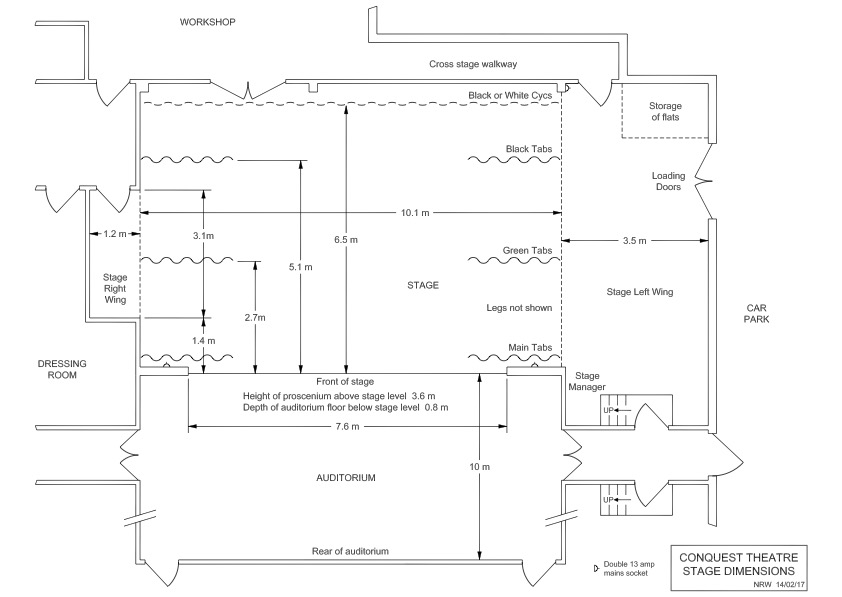
They can be viewed by clicking on the image OR downloaded by clicking on the coloured button.
282 Theatre
All Times Are Estimated!!
Arrive
Any time after 10:00
Stage Get In
10:35 (ten minutes – load directly to the stage)
Tec Time
10:45 (twenty five minutes – including loading to back stage)
Stage Set
12:20 pm (ten minutes)
Performance
12:30 pm
Adjudication Time
3:25 pm
Get Out
4:00 pm
Impact
All Times Are Estimated!!
Arrive
Any time after 10:00
Stage Get In
11:45 (ten minutes – load directly to the stage)
Tec Time
11:55 (twenty five minutes – including loading to back stage)
Stage Set
1:10 pm (ten minutes)
Performance
1:20 pm
Adjudication Time
3:30 pm
Get Out
4:00 pm
LADS
All Times Are Estimated!!
Arrive
Any time after 10:00
Stage Get In
11:10 am (ten minutes – load directly to the stage)
Tec Time
11:20 (twenty five minutes – including loading to back stage)
Stage Set
2:15 pm (ten minutes)
Performance
2:25 pm
Adjudication Time
3:30 pm
Get Out
4:00 pm
.
Norbury Players
All Times Are Estimated!!
Arrive
Hopefully you’re already in watching the shows!
Stage Get In
4:30 pm (ten minutes – load directly to the stage)
Tec Time
4:40 pm (twenty five minutes – including loading to back stage)
Stage Set
5:40 pm (ten minutes)
Performance
5:50 pm
Adjudication Time
8:10 pm
Get Out
8:40 pm
Wordsley Amateur Dramatic Society
Have withdrawn from the festival.
The Grange Players
All Times Are Estimated!!
Arrive
Hopefully you’re already in watching the shows!
Stage Get In
5:05 pm (ten minutes – load directly to the stage)
Tec Time
5:15pm (twenty five minutes – including loading to back stage)
Stage Set
7:00 pm (ten minutes)
Performance
7:10 pm
Adjudication Time
8:10 pm
Get Out
8:40 pm
What are the adjudicators looking for?
I’ve been asked this a lot! Below is a brief guide. Obviously every adjudicator is different, so please treat this information as guidance only.1. STAGE PRESENTATION (15 marks)While not a scientific measure, the Stage Presentation category can loosely be split into three key areas:Set, Scenery & Props – 5 marksA minimal or bare stage can work well—marks won’t be deducted if it aligns with the production’s style, genre, or creative intent.
Ask: Are the chosen set pieces, scenery, and props suitable for the play’s time period and setting?
Is the layout functional for the performers? It’s common to see awkward furniture placement that hinders movement and staging.Costume, Makeup & Masks – 5 marksA “head-to-toe” costume checklist is essential—especially for pieces with a specific period or social setting.
Common missteps include mismatched footwear or modern accessories, such as trainers in a Victorian piece. Also be mindful of contemporary details like tattoos or piercings.
Black clothing is acceptable where fitting, particularly in physical theatre. Quick costume changes for multi-role work can be effective but should be slick and stylised.
Masks can add impact—if used correctly. Performers must embody the character physically, and strong vocal skills are crucial when speech is involved.Sound, Lighting & Tech – 5 marksThese technical elements should be used with care and precision—they have the power to transform a scene but can just as easily distract.
Avoid jarring effects like unnecessary blackouts or overpowering follow spots.
Be wary of sound levels: music or effects should enhance, not drown out, the performance. One infamous example? A deafening helicopter sound that had the audience ducking!
Music should fade out naturally—abrupt cutoffs can spoil a moment.
The use of projections has increased, inspired by modern practitioners such as Katie Mitchell and Frantic Assembly, and can be highly effective when used creatively.2. DIRECTION (35 marks)A few questions to consider.Has the script been clearly interpreted?Does the opening establish confidence, tone, and style?Is that style consistent and suitable for the piece?Are the action and pacing carefully structured, with thoughtful staging and smooth transitions?Do the characters and narrative progress convincingly, with key moments clearly defined and impactful?Where ensemble work is central, is it cohesive and imaginatively handled?Above all, does the production move forward with clarity and intention?This section recognises the director’s vision and their ability to unite the cast in delivering a coherent, impactful production. We look for imagination, leadership, and evidence of a structured rehearsal process.Each element below can be marked out of 5, though flexibility is allowed depending on the nature of the production:
It often reflects the cumulative quality of the previous three categories—but also gives room to reward productions that make a lasting impression, even if there are a few inconsistencies in execution.
A particularly moving, exciting, or imaginative performance may warrant a higher score here.
Rules of AETF
HOW DO WE ENTER?
AETF ENTRANTS RULES
1. Entry into the National Festival must be via a Preliminary Festival, either a local festival organised by the AETF or an independent local festival affiliated to the AETF.
2. Any company:
2/1. Who desires to enter the AETF competition must declare this on the Preliminary Round entry form. 2/2. Companies must provide a completed AETF Declaration immediately following their selection.
3. A company may: –
3/1. Enter and opt with any number of plays in a Preliminary Festival.
3/2. Enter as many festivals as they like, but can only opt from one, preferably their local Preliminary (First Round) Festival.
3/3. Enter more than one Festival with different plays and opt.
4. By entering the AETF Festival companies commit themselves to performance at each level if selected and are expected to appear. Those pulling out at short notice without what is deemed reasonable cause will be refused entry for the subsequent year’s competition.
5. A company may not recast more than 25% of its roles unless it is from within the existing cast or by circumstances that are deemed extraordinary.
THE FOLLOWING POINTS ALSO APPLY!
6. Dramatic Schools for the training of professional actors are not eligible.
7. Any copyright recorded speech or projection of film or TV material can be used as long as proof of permission is produced.
8. Curtain calls are not permitted.
9. Written adjudications can be arranged for companies provided a written request is made to the organisers, together with necessary fee, before the festival.
The following are accepted by the ‘British Final of One-Act Plays’ governing body the United Kingdom Community Drama Federation (UKCDFF) and must be adhered to by all competing teams in the UK at all levels of the competition.
WHO CAN ENTER?
10. Any bona fide adult amateur Society, or recognised Youth Theatre.
Definition of a professional group: A professional group performs an activity to earn an income, whereas an amateur group performs an activity as a hobby.
A group’s public presence/marketing must clearly demonstrate a group’s amateur status and must not promote professional work.
Any festival production must not be available to hire for financial gain.
11. All players must be amateur i.e. whose main income is not earned by acting.
WHAT CAN WE ENTER?
12. All performances are subject to the Theatres Act 1968 and must comply with its provisions regarding plays, which might be considered obscene, seditious, or libellous, or likely to incite racial hatred or a breach of the peace.
13. The entry will be a One-Act Play or an extract from a longer play. The accepted definition of a one-act entry is ‘a coherent piece of mainly spoken drama’.
14. No play in copyright may be performed without production of its performance licence and written permission must be provided for any cuts or alterations.
15. The performance must be performed as per the script provided for the adjudicator, which must be with the adjudicator at least three weeks before the performance.
16. Only hard copies of scripts are accepted. Photocopies are only acceptable with the written permission of the publishers.
17. Each entry must have a minimum of two speaking characters appearing on stage.
WHAT ARE THE TIME CONSTRAINTS?
18. The length of performance of the entry shall be not less than 20 minutes and not more than 55 minutes, including any time spent in changing a scene in the course of a performance or time used to set the mood by the cast or music before the tabs open.
19. Each team will be allowed 10 minutes for setting and 5 minutes for striking their set.
20. Penalties for not keeping within times for performance, setting and striking are: –
· Up to 1 minute 1 mark
· Up to 2 minutes 3 marks
· Up to 3 minutes 6 marks
· Up to 4 minutes 10 marks
· Up to 5 minutes 15 marks
· Over 5 minutes Disqualification.
WHAT ARE THE STAGING CONSTRAINTS?
21. Any set or scenery must be free standing within the provided ‘black box’ acting area.
22. Societies have a duty to co-operate with the Festival Stage Director in adhering to the theatre’s safety rules and attending all safety briefings as required, please be aware that there may be different requirements in each country.
23. Societies must give advance notice to the Festival Stage Director of any additional equipment, which must comply with the theatre’s requirements. And any effects such as naked lights or smoking, fire arms or pistol shots, knives or swords, strobes etc which the theatre will need to be made aware of.
24. Projectors and projector screens must be provided by the company and are not the responsibility of the festival. These must be rigged in the 10 minute setting time.
25. The use of any kind of microphone will not be allowed to enhance an actor’s vocal projection. Microphones may still be used as a sound effect. In the interests of inclusivity microphones would be allowed in order to facilitate a deaf or hard of hearing member of the casts use of an induction loop.