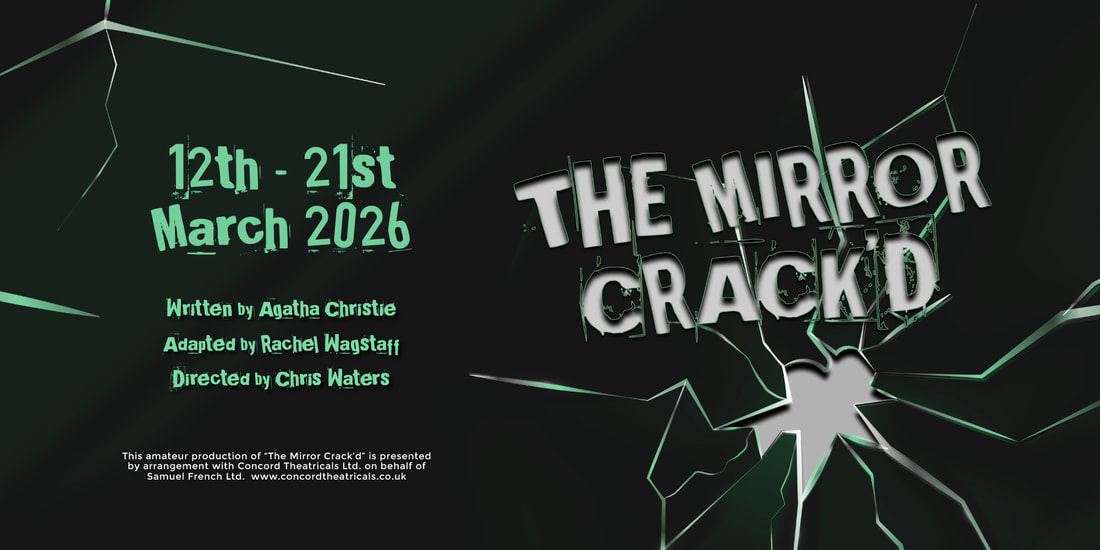
There’s something especially pleasing about watching a classic Agatha Christie mystery unfold on stage, and The Grange Players’ production of The Mirror Crack’d, adapted by Rachel Wagstaff, offers a thoroughly enjoyable evening of intrigue and character.
The first thing that stands out is the striking split-stage design. One side of the stage glows in deep reds, representing the dramatic world of Gossington Hall and its glamorous resident, Marina Gregg. The other provides a calm contrast: the soft whites and creams of Miss Marple’s home. This visual separation works well, not only establishing two distinct settings but also subtly reflecting the divide between the glitz of celebrity life and the quiet observation from which Miss Marple conducts her investigations.
The story begins not at the now-infamous party itself, but afterwards, with Miss Marple hearing about the event and the sudden death that followed. From there, the narrative unfolds through recollections and flashbacks, gradually reconstructing the evening as different characters describe what they saw — or what they believe they saw. It’s a structure that suits the mystery well, allowing the audience to piece together the puzzle alongside Miss Marple.
The split stage helps these transitions flow naturally between past and present. At times it did seem to present the cast with the occasional blocking challenge, simply due to the amount of movement and shared space, but these moments were minor and never enough to distract from the story being told. One particularly effective moment came when the suspects were arranged together in what felt like a police line-up, forming a striking tableau. It offered a brief visual pause, giving the audience a chance to consider each possible culprit and reminding us just how many motives might be hiding beneath polite village conversation.
The period setting was nicely supported through thoughtful costume and lighting choices, helping to distinguish between the calm familiarity of Miss Marple’s home and the more heightened recollections of events at Gossington Hall. Like many Christie mysteries, the play balances darker themes with moments of humour, and the audience responded warmly to those lighter exchanges. Beneath the “whodunnit,” there’s also a reflective undercurrent about memory, regret, and how the past can ripple into the present in unexpected ways.
This very much felt like a true ensemble piece, with a strong sense of shared purpose across the cast. At the centre, Sam Allan’s Miss Marple was warm, assured and quietly authoritative. She captured the character’s gentle exterior while always suggesting the sharp, observant mind beneath it. Her performance was measured and natural, never overstated, and held the audience’s attention with ease.
Chris Lambeth brought real substance to Inspector Craddock, giving the role a grounded and thoughtful presence. His performance balanced professional focus with a more human, responsive side, and his scenes with Miss Marple carried a convincing sense of mutual respect.
Tina Williams fully inhabited Marina Gregg, creating a striking stage presence. There was an almost dreamlike quality to her movement, as if slightly removed from those around her, which suited the character beautifully. Beneath the glamour, she revealed hints of vulnerability and emotional complexity that gradually deepened as the story unfolded.
Among the supporting roles, there was plenty to enjoy. Car Horton and Amanda Glover worked well as Jason Rudd and Heather Leigh, bringing clarity and a natural ease to their scenes. Abby-Leigh Simpson and Rosie Rimmer, as Lola and Cherry, added energy and lightness, helping to lift the mood at key moments while still feeling grounded within the world of the play. Kit Vance, as Ella Zielinsky, made a strong impression, bringing a clear sense of character and presence that ensured the role stood out within the wider ensemble.
Ray Lawrence, as Giuseppe Renzo, clearly relished his role, maintaining his Italian accent with confidence throughout, which added a touch of characterful humour. Robert Onions captured a fitting sense of bewilderment as events grew ever more complex, offering a nice contrast to some of the more assured figures on stage. Sarah Mason’s Dolly Bantry brought warmth and familiarity, helping to root the story in a recognisable and welcoming world.
Much of the production’s cohesion is owed to the direction of Chris Waters, who demonstrates a clear understanding of the genre. The mystery unfolds at a steady pace, allowing tension to build without ever feeling rushed, while the lighter moments are given space to breathe. His direction makes strong use of the full ensemble, ensuring that even smaller roles contribute meaningfully to the overall atmosphere.
All in all, The Grange Players have delivered a thoughtful and engaging production. With its bold set concept, committed performances and carefully storytelling, The Mirror Crack’d continues to hold an audience’s attention — right up to the final revelation. Just remember — if you’re invited to a quiet village cocktail party, it might be wise to politely decline.
Reviewed by – David T
No responses yet