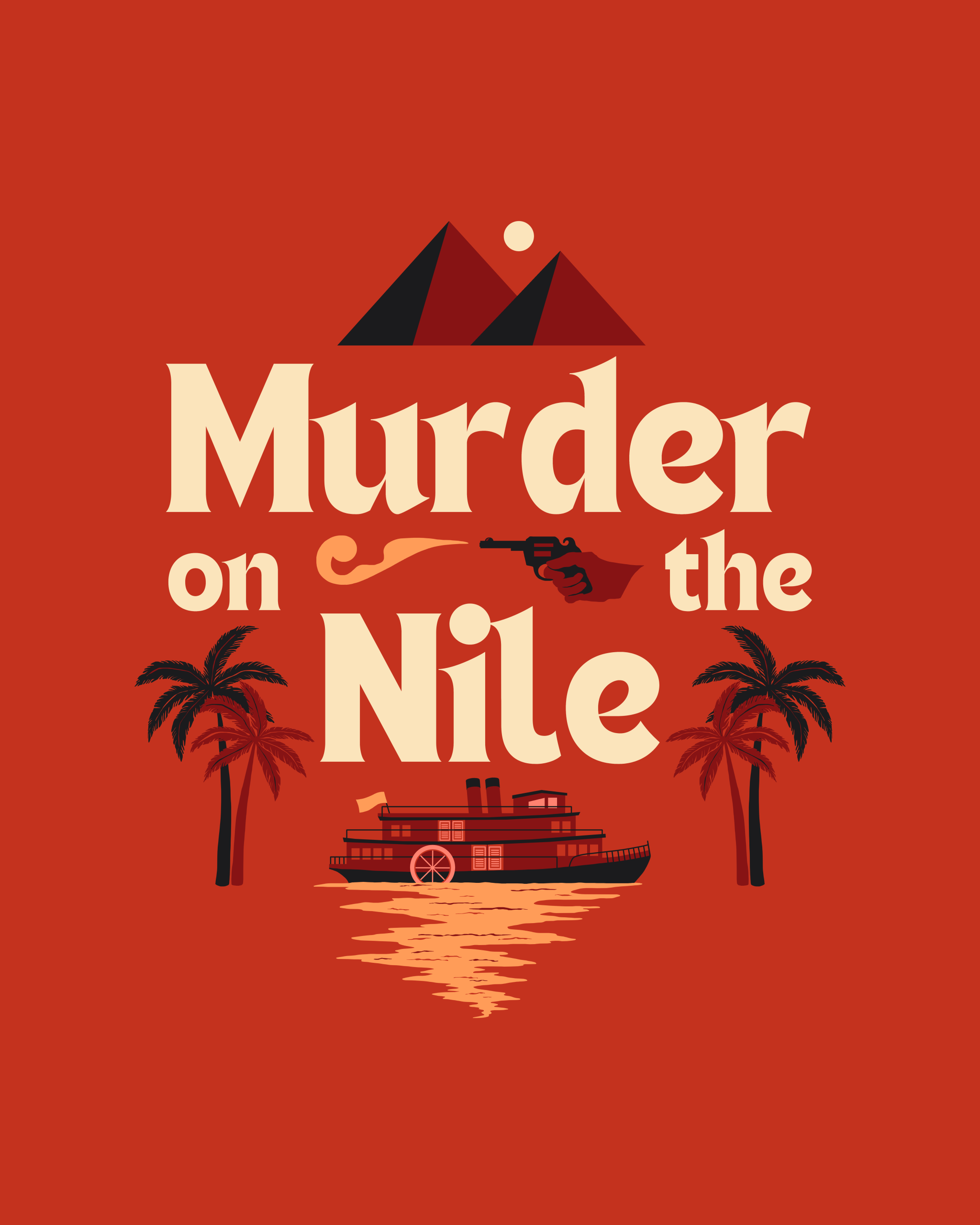
by Agatha Christie
Director Ken Agnew
Thursday 22nd October 2026
“Murder on the Nile” started life as novel, “Death on the Nile”, which was written in 1937 and adapted by Agatha Christie herself into play form, with its premiere performance in 1944. The original novel features Hercule Poirot and was adapted into two film versions (using the book title) – in 1978, starring Peter Ustinov and in 2022, with Kenneth Branagh in the lead role. For the play version, Christie apparently felt that Poirot wouldn’t work on a stage setting and he was effectively replaced by a stand-in, Canon Ambrose Pennefather.
For the record, I am a sucker for a bit of Christie and have lost track at how often I’ve seen “The Mousetrap”, “And Then There Were None” or “The Mirror Crack’d” but this one had managed to slip under my radar so I was glad of the chance to plug that gap.
We opened with a magnificent set depicting the saloon bar on a river cruise ship traversing the eponymous river. This was staged over two levels, with a raised bar area at the back of the stage, which appeared to be very well stocked. On the lower level were several tables. Some good use of panelling on either side of the stage and a very good touch was the handrails that were visible outside the saloon “windows” which very much helped to enhance the setting.
Unfortunately, there were a couple of occasions when we lost a couple of lines of dialogue when characters were delivering lines from the back, but not enough to entirely detract from the evening.
We had the usual Christie variety of characters, this time with a variety of accents to go with them. From an outrageously (mostly) Italian Steward (possibly from the region of Brumbardy!), the Scottish Christina, the French Louise, the Germanic Dr Bessner and the American Jacqueline, these were for the most part well sustained throughout the show. Louise’s French accent was particularly appropriate since for her opening scenes she appeared to be cosplaying Yvette from “’Allo! ‘Allo!”
For some reason, we had two intervals in the course of the evening. Now, normally, you’d only have two intervals if it’s a particularly long play or if there were some elaborate set changes but this had neither – it was a normal length play and all presented on one set. Unfortunately, this did seem to impact on the pacing so personally, I’d have just gone with the standard single interval.
Pacing very much seemed to be an issue in the opening third. There is a lot of exposition as we are introduced to all the characters but this isn’t in and of itself a bad thing (as anyone who has seen a well-produced version of “Twelve Angry Men” will attest). Unfortunately, here it seemed to take a while to get going albeit that it did pick up along the way. It’s difficult to put a finger on specifics but it just seemed to lack energy and could have been a bit slicker. Granted, it picked up as it went along. A fair amount of the plot does seem to take place off stage but that’s a fault of the script rather than production.
We had the sort of period costumes that you’d expect for this era. I felt there could have been a bit more variety in the gents’ costumes as they all seemed to be in similar white or cream suits. More of a contrast with the ladies and a range of colours here.
There was a good use of props throughout and I was glad to see that when characters were meant to be drinking they actually were – no knocking back from empty cups here.
We had an excellent cast for this performance, as you’d expect from Highbury who all gave us believable performances in the contrasting characters, even when (as alluded to above) having to maintain an accent as well. I think I only noticed one prompt all night which always a good sign.
There were a couple of lines at the start that were delivered from the back of the stage which were a bit hard to hear but after this everything was fine.
The cast was led by Alan Groucott in the role of Poirot substitute Canon Pennefather. This was a very thoughtful and subtle performance, giving the air of someone on the outside who was always observing, a good characteristic for a Christie detective to have.
Nathan McNaught was suitably boorish as William Smith, the man with the hidden past, albeit that’s not unique in a Christie. Nathan was fully engaging in this role and was responsible for a lot of the humour.
Kerry Prosser gave us an appropriately haughty performance as the social climber Miss ffoliot ffoulkes (I’m not making the capital F mistake here!) and she worked well in partnership with Amy White as Christina.
Paul Merrell and Isobel Clinton were another effective pairing in the roles of Simon and Kay Mostyn. Robyn Klein-Christoffels was an excellent foil in the role of Simon’s former love interest.
Ron Parker certainly amused the audience in his role of the Italian Steward, a perfect example of how to take on a minor role and get noticed.
Overall, this wasn’t a bad show by any stretch of the imagination – in all my years of attending Highbury I don’t recall seeing a bad show – but I just felt that a few tweaks could have turned this from good to very good.
However, still an entertaining evening and a worthy entry into the Christie world.
Reviewed by – David G.
Comments are closed