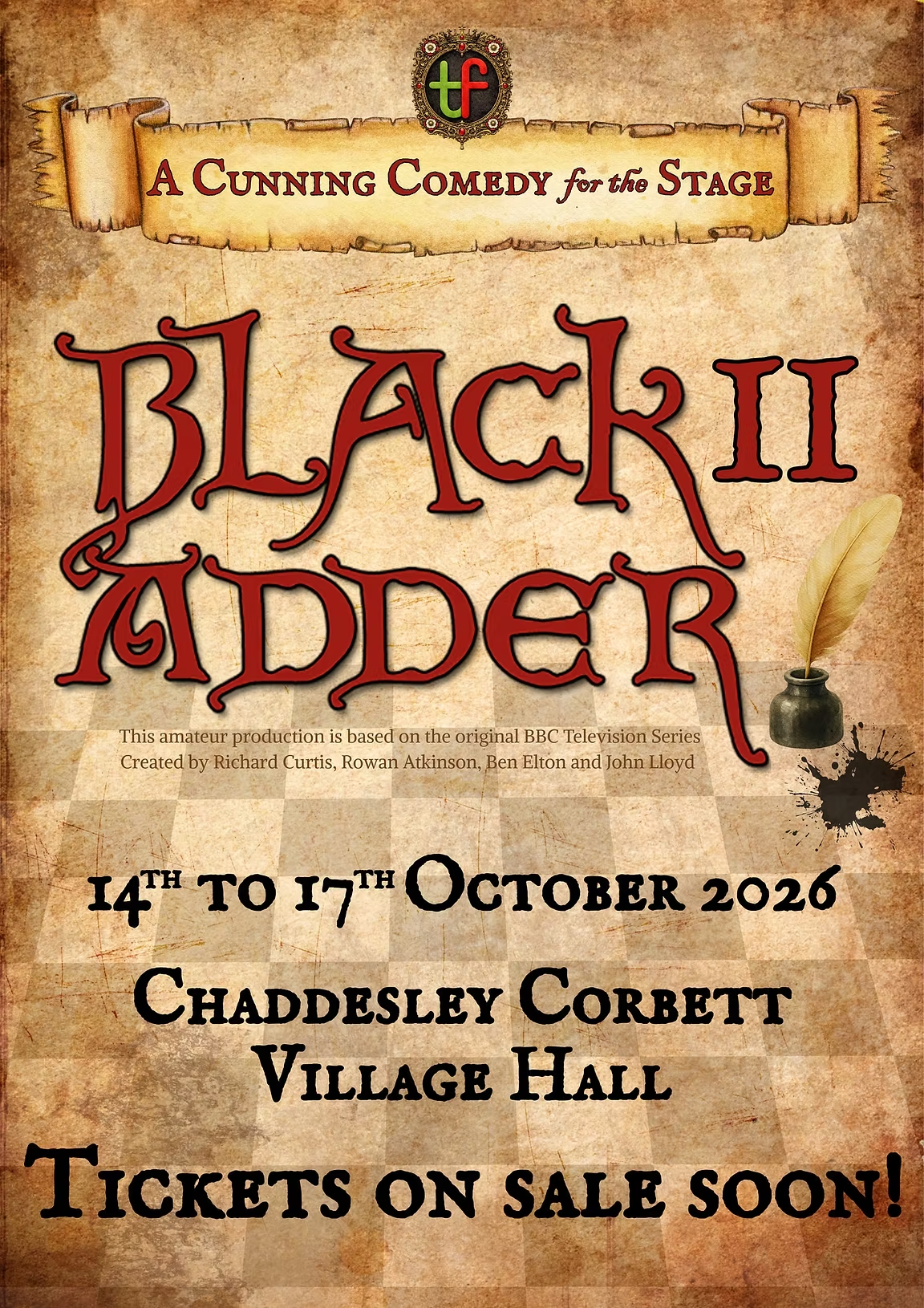
I always find television and film adaptations for the stage a little tricky. You want to see the original stars perform, and sometimes it’s hard not to feel a little cheated when you can’t. With a cast originally featuring Rowan Atkinson, Tim McInnerny, Tony Robinson and Miranda Richardson, it’s easy to see why. These are characters and performances that have become part of British comedy history.
Then there’s the material itself. For me, Blackadder was the show that myself and all my friends seemed to learn by heart. We could recite pages of it, simply to amuse ourselves. So watching an amateur company perform a show when you know every line, every look and every plot twist could easily have been a recipe for disappointment. However, something rather wonderful happened. I laughed. In the first scene, “Yes, Kate, I want you to become a prostitute!”, I was sold. From that point on, I sat back and simply enjoyed the show.
Tinkers Farm Opera brought us three episodes from Blackadder II: Bells, Head and Beer. For those who may not know the stories, here’s a brief synopsis of each.
Bells
Edmund Blackadder takes on a new servant, the handsome young Bob, and finds himself developing rather unexpected romantic feelings. There’s just one problem: Bob is actually Kate, a woman disguised as a man. When the truth comes out, Edmund’s romantic plans take a decidedly unexpected turn, with mistaken identity, wedding plans and the arrival of the outrageous Lord Flashheart adding to the chaos.
Head
Blackadder is appointed Lord High Executioner by Queen Elizabeth I, a position that seems to offer considerable status but comes with one rather awkward responsibility: carrying out executions. When he discovers that he has failed to execute someone on the Queen’s list, he must find a way to put things right before his own head ends up on the chopping block.
Beer
Edmund is preparing to entertain his deeply Puritan relatives, Lord and Lady Whiteadder, who consider almost every pleasure in life sinful. Unfortunately, he has also arranged a drinking party with his rather less restrained friends. With both gatherings taking place under the same roof, Edmund must keep the two worlds apart. Inevitably, things begin to unravel, leading to a gloriously comic clash between Puritan piety and drunken excess.
So, on with the cast.
Richard Cooper made a very convincing Edmund Blackadder, capturing the character’s sarcasm, arrogance and wonderfully dry delivery. He also looked the part, with a rather splendid beard that certainly helped complete the image! His comic timing was good, allowing those familiar lines to land and giving the audience plenty to enjoy. Really nice work here, Richard.
Dominic Butters was perfectly cast as Lord Percy, with a great voice that matched the character beautifully. He captured Percy’s well-meaning but decidedly dim nature just as it should be, bringing the right amount of daftness to the role. The kissing scene with Baldrick was a particular highlight!
Talking of Baldrick, Phil Lines made a suitably memorable Baldrick, and there was another excellent beard to admire! One particular highlight was the delivery of the turnip shaped like a giant… well, let’s just say it was distinctly anatomical! It was exactly the sort of wonderfully childish humour that Blackadder does so well, and the line clearly hit the mark, along with those arrows in the first scene. It was another moment that had the audience in stitches.
Evan Johnson was excellent as Bob, with particularly good comic timing and a convincing change in character as the story unfolded. Playing a character whose true identity is central to the humour takes careful handling, and Evan made the transformation work, helping to bring the comedy of Bells to life.
Gareth May was fantastic as Lord Flashheart. “Woof, woof!” He delivered the character with all the confidence and outrageous energy the role demands, making Flashheart a real highlight. So much so that Gareth even managed to keep the audience entertained during a change between episodes!
With such a big, larger-than-life character to play, we almost didn’t notice him in his other roles. And that is certainly not a criticism, quite the opposite. It is a compliment to how completely he inhabited Flashheart that his other appearances passed so seamlessly.
Whose Queen? Well, Gabby Baldwin, as it turns out! She brought Queenie to life with all the giggles, childishness and mischievous fun needed to pull off this wonderfully over-the-top character. Gabby captured Queenie’s playful, unpredictable nature perfectly, giving us a Queen who was every bit as delightfully immature as the role demands.
James Baldwin gave a good performance as Lord Melchett, providing exactly the sort of pompous authority needed to complement Edmund’s scheming and sarcasm. He fitted the role well and worked nicely as a foil to Blackadder, helping to maintain the comic balance between the two characters.
Alyson Nunn certainly had her work cut out, taking on several different characters throughout the production. She rose to the challenge admirably, giving each character their own identity rather than allowing them to blur into one another. Whether as Lady Farrow, the Young Crone or Geoffrey Piddle, Alyson made each role her own. And, of course, she successfully showed us the way to the Wise Woman! A versatile performance that added plenty to the production.
Megan Smith was equally convincing across all three of her roles, although Lady Whiteadder was probably the largest of the parts. I’ve always had a particular fondness for Mr and Mrs Ploppy, and “the long winter evenings must fly by” never fails to amuse me. Megan delivered each character really well, bringing the right qualities to each and ensuring that none felt like a repeat of the previous role. A solid, consistent performance throughout.
Geoff Westwood was another actor who handled his multiple roles with ease. From the outset as Kate’s Father, through to the wonderfully entertaining Mr Ploppy, and finally finishing as Lord Whiteadder, Geoff delivered each character confidently. And perhaps the best part of all was that he saved Lord Whiteadder until the end, with far fewer lines to learn! A good performance across three very different characters, with Mr Ploppy being a particular highlight.
Nursey is a star and certainly shouldn’t be overlooked! Lynda Dunn was perfect for the role of Bernard, bringing just the right touch to a character who might otherwise be lost among the bigger personalities. Sometimes it’s the smaller roles that leave a lasting impression, and this was a lovely example of making the most of the part.
Direction – Bringing Blackadder to the Stage
Directing Blackadder II is no easy task. The original television series is so familiar to many of us that the audience arrives with its own expectations of the characters, the comedy and, perhaps most importantly, the timing. There is also the challenge of translating three well-loved episodes to the stage without losing the spirit of the original or simply trying to imitate what has gone before. Emma Harley should be congratulated.
The staging made good use of the available space, with a split-stage arrangement allowing Edmund’s house to sit on stage left, while the castle and other locations occupied stage right. The stage was intimate to begin with, and dividing it in two inevitably restricted the room available to the actors. Nevertheless, the Emma made the best of the space, creating a workable setting for the action to unfold.
What worked particularly well was the way the production remained faithful to the original material, understanding that much of the humour lies not just in the words but in the physical comedy and the timing. I’m thinking particularly of Head, where Edmund, unable to see beneath the bag over his head (don’t ask!), follows the sound of his approaching “wife” only for her to walk in the opposite direction. It was a lovely moment that captured the absurdity of the original and translated it effectively to the stage.
The transitions between episodes also provided an opportunity to keep the audience entertained, rather than allowing the energy to drop while the scene was changed. Gareth May, in particular, helped maintain that connection with the audience, demonstrating that the comedy didn’t have to stop simply because the next episode wasn’t quite ready to begin.
Ultimately, this felt like a production that understood exactly what makes Blackadder II so beloved. The combination of a well-written script, strong performances, physical comedy and excellent timing allowed these classic episodes to flourish on stage once again.
I can only congratulate everyone at Tinkers Farm. It was a thoroughly enjoyable night out, one I hope we can do again – with any luck.
Luck – Way hay!
Reviewed by David T.
Comments are closed